
Floyd County Warrant Checks
Begin with the paper itself. Floyd County publishes no countywide warrant list and no public sheriff warrant search, so the court named on a citation, summons, or letter is your starting point. Felony cases belong to the 110th District Court and its District Clerk. County Court keeps its own criminal docket. A ticket from Floydada or Lockney goes back to that municipal court. A precinct citation belongs with JP 1 & 4 or JP 2 & 3. Unknown issuer? The Sheriff's Office main line can help route the call, though it posts no warrant hotline. Have the person's full legal name, date of birth, and any citation, cause, or notice number ready. Then ask the real question: is the record active, served, recalled, quashed, paid, or still open? Follow up by asking which office controls the next step. A relative can place that routing call, but the court may want details from the person whose case it is. A blank search screen proves nothing either way. No third-party result can confirm the status of a Floyd County court record.
- Call the issuer printed on the citation or court notice; ask for the current warrant status.
- For an unknown countywide matter, call the Floyd County Sheriff’s Office and ask which court to contact.
- For an FTA or unpaid-ticket report, check OmniBase for your own compliance record, then call the court.
- If phone help is not enough, send a focused Texas Public Information Act request to the office holding the record.
- Before appearing or paying, ask the issuing court or a lawyer about the exact recall, hearing, or bond process.
No Floyd County Warrant List
The Floyd County sheriff's page offers no name-search box and no active warrant list. It gives an office address and a main phone, nothing more. It links to VINELink for custody information. That answers a different question than whether a court warrant is open. A custody page, a commercial search result, or a list for another state's Floyd County is not a local record. Skip those shortcuts. The Floyd County Sheriff's Office page lists 125 E California Street in Floydada and 806-983-4901. It names no warrant unit, warrant email, bond window, or walk-in schedule. Call before you drive.
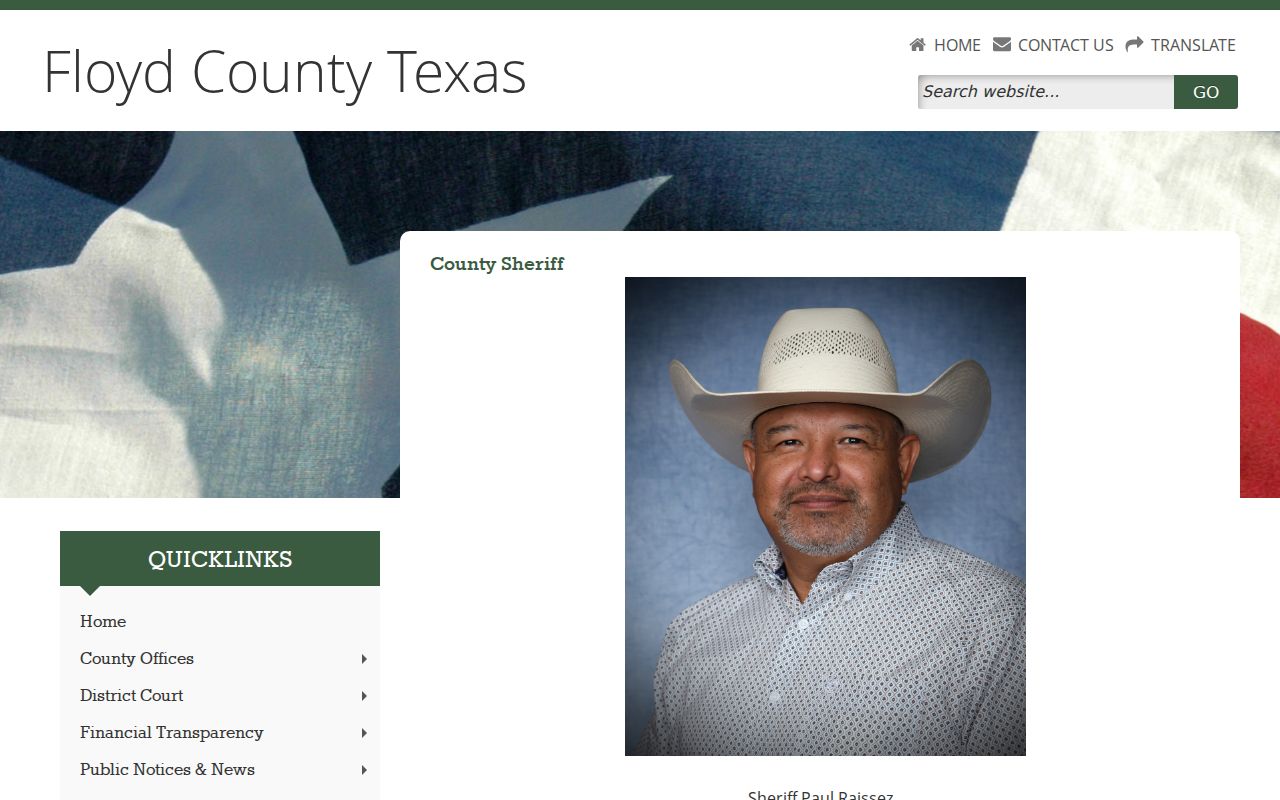
Use the listed number to ask which Floyd County court holds the record. The page itself does not confirm any warrant's status.
Warrants in Floyd County: The Main Types
Labels matter here. Each paper has its own trigger and its own issuer. A probable-cause arrest warrant ties to an alleged offense. A bench warrant follows a missed court duty or other noncompliance. A capias pro fine targets an unpaid fine judgment in a justice or municipal court, while a search warrant authorizes a search for items rather than a personal status lookup. In Floyd County, ask which court signed the paper before deciding where to call.
| Warrant Type | How It Arises | Who Issues It |
|---|---|---|
| Arrest warrant | Probable-cause process for an offense | Magistrate or court with authority |
| Bench warrant | Missed appearance or court requirement | Court handling the case |
| Search warrant | Probable cause to search for property | Magistrate under Chapter 18 |
| Capias pro fine | Fine judgment not met as ordered | JP or municipal court that entered it |
Floyd County’s Two Court Levels
The 110th District Court serves as Floyd County's felony and general-jurisdiction court. Its District Clerk holds the district criminal files. The Constitutional County Court takes county-court criminal matters on a separate record path. A citation from either incorporated city starts in that municipal court. Outside the cities, a JP court can hold a Class C or traffic case. The official Texas judicial directory lists both municipal courts and the two grouped JP courts. Use it to find an office, not warrants. In Floydada the JP and municipal court share an address but answer different numbers. The county JP page gives Floyd County's official court groupings. Verify the paper before you travel.
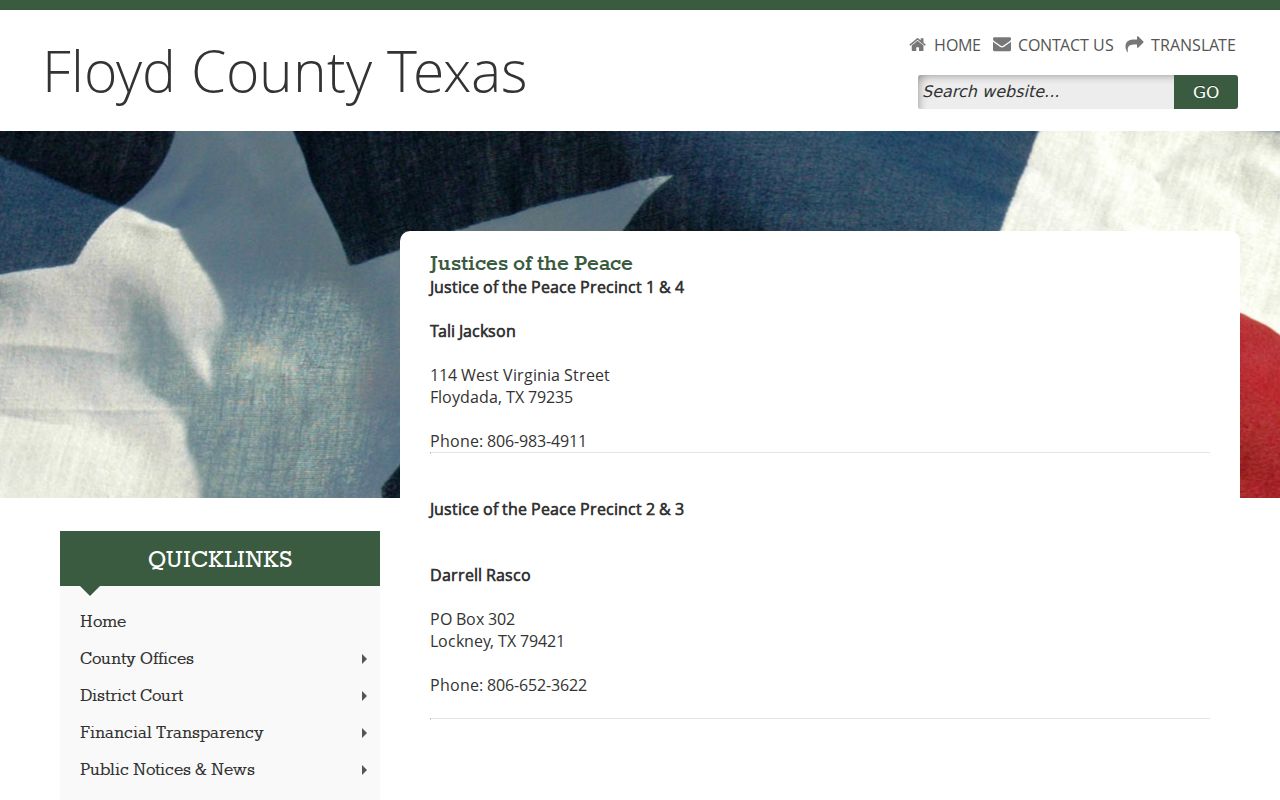
Use the precinct printed on a Floyd County citation to reach the court that keeps that local file.
Floyd County Warrant Records: What They Show
Floyd County posts no public warrant listing. That means there is no local display format or warrant-number pattern to describe. A court file may hold the issuing judge, the case or citation reference, the type, the reason, the date, the status, and any bond or fine details. It can also name the agency asked to serve it. Ask the clerk to explain anything unclear. Confirm whether the warrant itself or the underlying case remains open.
| Warrant number | Floyd format not published; ask the issuing court. |
|---|---|
| Case reference | The District Clerk’s example 4500 is a case number, not a warrant number. |
| Charge or reason | May identify the offense, missed setting, fine judgment, or other court process. |
| Issuing court | District, County, JP, or municipal court, based on the case. |
| Bond or balance | Ask the court; Floyd schedules and amounts were not published. |
| Status | Ask whether active, served, recalled, quashed, cleared, or satisfied. |
Floyd County Case Numbers
The District Clerk reports that Floyd County case numbers carry no commas or hyphens. The office offers plain numeric examples and notes that a pending tax case may carry "TS" after its number. That guidance covers only the clerk's case numbers. It says nothing about the format of a warrant, citation, or municipal-court reference.
- Capias
- Texas process ordering a defendant’s arrest or production in certain case stages.
- Capias pro fine
- A justice or municipal court’s fine-judgment process under Chapter 45A.
- Recalled
- The issuing court has withdrawn the warrant; ask when other records will update.
Floyd County Warrants: Who Issues, Who Serves
Courts and magistrates issue warrants. Peace officers carry them out. The 110th District Court and other authorized magistrates handle the felony path in Floyd County. The two JP groups plus the Floydada and Lockney Municipal Courts handle many local Class C, traffic, ordinance, and fine matters. The sheriff serves as the countywide law-enforcement contact. Floydada runs its own police department page, while Lockney's city contact page routes uniformed dispatch to the sheriff.
Floyd County Sheriff’s Office
125 E California Street
Floydada, TX 79235
806-983-4901
Warrant Service Can Cross Agencies
Floyd County warrant service can draw a crowd. Local reporting in 2025 described a joint operation with the sheriff, Floydada Police, U.S. Marshals, and a regional tactical partner. A 2024 report also told of sheriff deputies getting regional SWAT help during a service. Execution clearly crosses agency lines. It still does not create a public warrant list. Nor does it show which office controls a particular case. Call the issuing court for status. Ask which agency holds the warrant for service. The court alone controls recall, bond, and case settings. A serving agency answers only its own custody or handoff questions. When a notice names both a court and an officer, keep the roles distinct.
Handling a Floyd County Warrant
Start by confirming which court issued the warrant. Then check whether the entry is still active. Ask that court whether a new setting, a recall motion, an appearance, payment, or a bond is the right next step. Floyd County posts no bond schedule. There are no walk-in surrender hours either, and no payment portal. Skip any general Texas bond example you find online. A lawyer can call the court, ask whether an attorney-arranged appearance is possible, and explain how the underlying case may continue after a warrant is cleared.
Important: Speak with a lawyer or the issuing court before appearing; ask about bond, booking, and whether the court can recall the warrant.
A Traffic Warrant Is Not an OmniBase Hold
A missed court date or an unpaid traffic judgment can bring court process in Floyd County. Separately, a participating court may report an unresolved citation through Texas's Failure to Appear/Failure to Pay program. OmniBase keeps that compliance record. It is not a statewide warrant database. A clear result does not prove every court warrant is gone.
| Record | Who controls it | What to ask |
|---|---|---|
| Court warrant | Issuing JP or municipal court | Current warrant and case status |
| FTA/FTP report | Reporting court and state program | Balance and reporting update |
| License renewal issue | Texas DPS program process | Whether the court cleared its report |
Warrant Record Access Under Texas Law
The Texas Public Information Act lets anyone ask the government body holding a record for non-exempt public information. Keep the request narrow. Send it to the sheriff, clerk, or court that keeps the file. A request does not guarantee release. Juvenile arrest warrants carry a special confidentiality rule. So does a search-warrant affidavit, which may stay closed until the warrant is executed. The Floyd County Clerk adds a limit of its own. Staff there will not conduct searches that statutes do not authorize, so the general records vendor is no warrant desk.
Key Rules:
Texas Government Code Chapter 552 sets the public-information request framework and its exceptions.
Texas Family Code §58.010 protects a child’s arrest warrant and supporting complaint or affidavit.
Texas Code of Criminal Procedure §18.01 ties public access to a search-warrant affidavit to execution, subject to exceptions.
The County Clerk Has a Search Limit
The County Clerk has posted a notice. Staff there do not run searches unless a statute authorizes them. The one search the notice names is federal tax liens. That matters here, because a general name search at the clerk's counter is no stand-in for a criminal or municipal court file in Floyd County. For a warrant question, go to the office that issued the process. You can also send a Chapter 552 request to the governmental body holding the record. No warrant-specific form, copy fee, turnaround promise, or appeal contact appears on Floyd County's official pages. In your request, state the person's own name, the date range, and the court or citation if known, plus the record status you want. If material gets withheld, ask the office to state its legal basis in the response.
Floyd County Court Geography
Floyd County covers a lot of ground. The court network is small, with the courthouse, the District Clerk, and the JP 1 & 4 contacts all in Floydada. Lockney is the public route for JP 2 & 3. It also houses the Lockney Municipal Court. That layout makes a notice's court name and precinct more useful than a broad countywide search request.
The U.S. Census Bureau's Floyd County QuickFacts supplies both figures. Those numbers describe the county, not its warrants or court cases.
City Warrant Records in Floyd County
Floyd County has two incorporated cities with municipal courts. Coverage follows population order: Floydada first, then Lockney. Each city court keeps its own ordinance, traffic, and failure-to-appear path. The 2020 population figures were 2,675 for Floydada and 2,106 for Lockney. Neither city posts an online warrant portal.
Floydada Warrant Records
2020 population: 2,675 · City police and municipal court use separate phone lines.
Lockney Warrant Records
2020 population: 2,106 · City Hall routes uniformed police dispatch to the sheriff.