
How Traffic Warrants Work in Floyd County
A traffic case can start with a citation. If a required appearance or payment is missed, the court may report a failure to appear or failure to pay, issue a bench warrant, or use a capias pro fine after a judgment. The exact order depends on the case and the court. No Floyd citation portal or local timing schedule was found.
County and precinct citations go to JP 1 & 4 or JP 2 & 3. City citations go to Floydada or Lockney Municipal Court. The issuing court confirms whether there is an active warrant, a separate compliance report, or more than one open item.
Floyd County Traffic Warrant Court Contacts
The court name on the citation is the first useful clue. Floydada’s municipal court and JP 1 & 4 share an address but use separate phone lines. Lockney’s municipal court and City Hall share a public number, while JP 2 & 3 has its own contact. Call the correct office before paying or traveling.
| Citation type | First contact | Phone |
|---|---|---|
| Floydada city citation | Floydada Municipal Court | 806-983-3615 |
| Precinct 1 or 4 citation | JP 1 & 4 | 806-983-4911 |
| Lockney city citation | Lockney Municipal Court | 806-652-2355 |
| Precinct 2 or 3 citation | JP 2 & 3 | 806-652-3622 |
Floyd County Traffic Warrant Checks
No Floyd online citation or traffic-warrant lookup was located. Begin with the issuing JP or city court and have the full name, date of birth, citation number, and any notice ready. If the issuer is unclear, the Sheriff’s Office main line can help route the call, but it does not publish a dedicated warrant desk.
- Read the citation for the court, city, or precinct and call that office directly.
- Ask whether the record is an FTA/FTP report, an active warrant, a capias pro fine, or more than one item.
- If the phone does not resolve the question, ask about a written record request or an in-person court contact.
- Before appearing or paying, confirm whether a judge, lawyer, or new setting is required.
Floyd County Warrant Routing by Precinct
There are no public search fields to copy from a local portal. These labels are the details to ask the court about. The “not exposed” entries mean no official Floyd interface was located, not that a court lacks an internal case record.
| Field | Public form | What to ask |
|---|---|---|
| Citation number | Not exposed | Give it to the issuing court. |
| Defendant name and DOB | Not exposed | Use for official matching only. |
| City or precinct | Not exposed | Floydada, Lockney, JP 1 & 4, or JP 2 & 3. |
| Warrant or case number | Not exposed | Ask which number identifies the court file. |
| Status or balance | Not exposed | Ask about active, recalled, served, paid, and current total. |
| Search or pay button | Not exposed | No online payment or reset method was found. |
Traffic Warrants: What They Show
Floyd County does not publish a sample citation-warrant entry, so a local number pattern cannot be shown. A court may keep the citation, case, or warrant reference, offense, due amount, issue date, status, and next setting. Ask which number belongs to the warrant itself and which belongs to the traffic case. They may not be the same.
| Warrant / citation number | No public sample; ask the court which reference applies. |
|---|---|
| Charge or offense | Use the description printed on the citation or court record. |
| Issuing court | JP 1 & 4, JP 2 & 3, Floydada, or Lockney. |
| Fine, cost, or bond | Confirm the exact current total with the issuing court. |
| Status | Ask if active, served, recalled, quashed, paid, or cleared. |
| Next setting | A warrant may be cleared while the traffic case remains open. |
Floyd County Capias Warrant Relief
The common path is citation, missed appearance or payment, a court report or order, and then a court-directed way to resolve it. A capias pro fine is tied to a fine judgment. It is not another name for every traffic warrant. Chapter 45A includes hardship and voluntary-appearance rules for justice and municipal court judgments.
Process: citation issued › court duty missed or judgment unpaid › FTA/FTP report or warrant process › court appearance, payment, hardship review, recall, or bond.
Ask the court which stage applies. A license-renewal report can exist alongside a court warrant, but one status does not automatically clear the other.
Clearing a Floyd County Traffic Warrant
Call the issuing court for the current amount and whether an appearance is required. Floyd County’s reviewed pages do not publish an online payment vendor, bond schedule, walk-in hours, or reset form. For a capias pro fine, ask about the Article 45A hearing and alternative-satisfaction options if full payment is not possible. A lawyer can ask whether a motion or voluntary appearance can lead to recall.
- Confirm whether the issue is a court warrant, a DPS/OmniBase report, or both.
- Ask for the current fine, costs, reimbursement, bond, and appearance requirements.
- Ask about payment, a new setting, a hardship hearing, alternative satisfaction, or counsel-arranged appearance.
- After the court action, get a receipt or order and ask when the record and any report will update.
Warning: Paying an FTA/FTP amount does not by itself prove the issuing court warrant is recalled; ask both the court and the program what remains open.
Floyd County Traffic Warrant and OmniBase
OmniBase administers the Texas FTA/FTP program for unresolved citations reported by participating jurisdictions. It is not a full warrant search. DPS says the person should contact the issuing court to confirm fines and costs, learn whether an appearance is required, or ask about a trial or payment arrangement. DPS license specialists cannot confirm warrants.
The OmniBase individual page says the database contains only reports from participating courts. A “no violation” result therefore cannot clear a municipal or JP warrant. If a report is cleared, the DPS materials give processing estimates of three to five business days in one explanation and up to seven business days in the FAQ. Those are program estimates, not local warrant-list timing.
The DPS FAQ directs readers to the issuing city or county for warrant information.
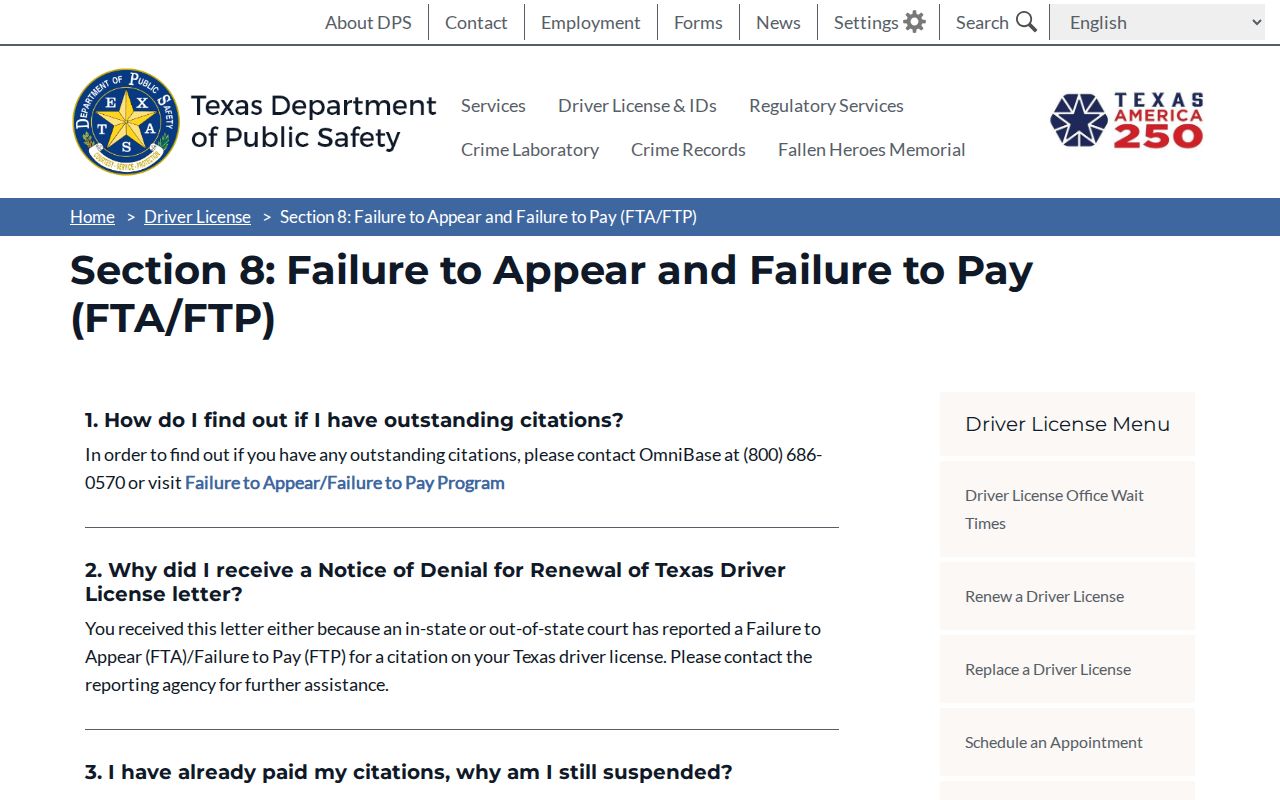
Use the FAQ to understand the compliance program, then ask the court about its separate process.
How Traffic Warrants Trigger License Holds
Chapter 706 allows a qualifying court-reported failure to appear or pay to affect license-renewal eligibility. That compliance hold is not the same as an arrest warrant or a capias pro fine. One citation can create more than one record, and each record can have a different release step. Chapter 706 also includes a $10 reimbursement fee per reported complaint or citation in applicable circumstances; the full Floyd amount is court-specific.
| Mechanism | What Triggers It | What It Does |
|---|---|---|
| Court warrant | Missed date or unsatisfied judgment, as ordered | Peace-officer process controlled by the issuing court |
| FTA/FTP report | Qualifying citation reported by a participating court | Compliance record handled through OmniBase |
| License-renewal hold | Unresolved qualifying report | May block renewal until the court reports closure |
Confirm Floyd County Traffic Clearance
After a payment, hearing, or court appearance, ask the issuing court which item changed and when it will report the result. A closed FTA/FTP report does not always mean the traffic case is finally disposed. Keep the court receipt or signed order, then check again through the official program after its stated update period.
DPS directs people to the issuing city or county for warrant information. The court can also tell you whether another setting remains. Do not treat an OmniBase result as proof that every court record is clear.
The official FTA/FTP portal is a personal compliance check, not a Floyd warrant portal.
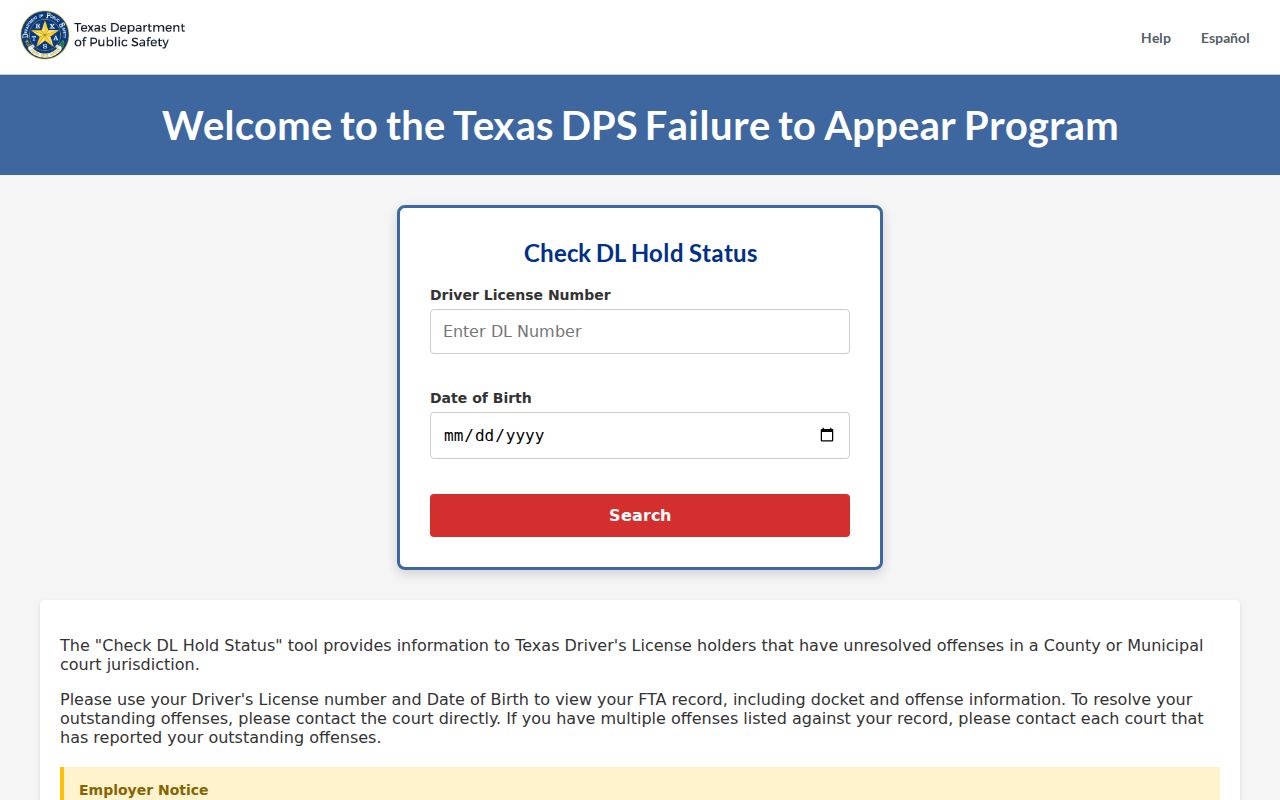
Use it for your own reported citation status and confirm court warrant closure separately.